








 Diagnostics








Ask five people in your organization where the revenue process starts and ends, and you’ll likely get five different answers. Sales will point to the first customer conversation. Finance will point to the invoice. Legal will point to the contract. Everyone’s right, which is exactly the problem.
Quote-to-cash and order-to-cash are often used interchangeably, even though they cover different territory, involve different teams, and break down in different ways. Both processes end in the same place: cash in the bank. But how they get there, and who’s responsible along the way, matters a great deal if you’re trying to fix a bottleneck, choose new technology, or simply figure out who owns what.
A simple way to remember it is this: quote-to-cash prepares the deal, while order-to-cash executes the order and collects the cash.
This blog breaks down each process and shows finance and revenue operations leaders where they overlap, where they diverge, and where to focus improvement efforts first.
Understanding quote-to-cash
Quote-to-cash isn’t just a longer name for the sales process. A basic sales motion might end when a deal is signed but quote-to-cash keeps going. It spans sales, finance and legal, and it doesn’t stop until the customer has actually been billed and collected on for what they agreed to buy. That distinction matters because this is often where things fall apart. A deal can close cleanly and still generate a billing error, a missed renewal, or miss a contract term in the invoicing system.
What is quote-to-cash and how does it work
Quote-to-cash is the end-to-end process that begins with a customer inquiry and ends when payment is collected. It’s not owned by a single department. Sales initiates it, finance and legal shape the commercial terms along the way, and operations often ends up managing the handoffs between systems.
Key benefits and business applications
Quote-to-cash earns its keep in complex selling environments such as long or negotiated sales cycles, subscription and usage-based models, and businesses selling configurable products or bundled services. If your sales team is assembling custom quotes, negotiating terms, or managing tiered and usage-based pricing, a disciplined quote-to-cash process is what keeps those deals from turning into costly billing headaches later.
Quote-to-cash process steps and stages
While exact steps vary by business, quote-to-cash generally moves through:
- Configuration and pricing. Sales configures the product or service and applies pricing rules, discounts, and tiers.
- Proposal. A formal quote or proposal goes to the customer.
- Negotiation. Terms, pricing, and scope get worked out, sometimes over several rounds.
- Contract. The agreement is finalized and signed.
- Fulfillment. The product or service is delivered or provisioned.
- Invoicing. The customer is billed according to the contract terms.
- Payment. Cash is collected and applied.
Understanding order-to-cash
Order-to-cash gets confused with a standard accounts receivable function, but it’s broader than that. AR is one piece of it. The order-to-cash cycle covers the entire path from the moment an order is confirmed through the moment cash is collected and reconciled against the books.
What is order-to-cash and how does it work
Order-to-cash begins when a confirmed order is placed, not when a prospect first shows interest. It ends when payment is received and reconciled against the ledger. Compared with quote-to-cash, it’s a more linear, operational process: less negotiation, more execution.
Key benefits and business applications
Order-to-cash is built for volume. It’s where high-transaction businesses, distributors, manufacturers, and companies selling standard products at set prices find the most value. When the product is the same for every customer and the pricing doesn’t require negotiation, order-to-cash provides a repeatable, scalable way to move orders through fulfillment and into cash.
Order-to-cash process steps and stages
A typical order-to-cash cycle includes:
- Order management. The confirmed order is captured and validated.
- Fulfillment. The product ships or the service is delivered.
- Invoicing. An invoice is generated based on the order.
- Payment collection. The customer remits payment.
- Cash reconciliation. Payment is matched against the invoice and the books are closed.
Quote-to-cash vs. order-to-cash: A side-by-side comparison
Here’s how the two stack up across the factors that matter most for operational decisions:
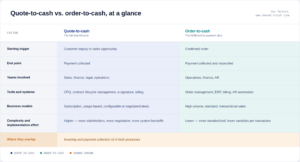
Quote-to-cash effectively hands off to order-to-cash-style execution once a deal closes. Fulfillment, invoicing, and collections happen in both. That’s usually where the two processes need to talk to each other, and where a lot of companies discover their systems don’t.
Common misconceptions about quote-to-cash and order-to-cash
A few points of confusion come up often enough they should be called out directly:
- They’re not the same process with different names. Quote-to-cash includes the negotiation and configuration work that happens before an order exists. Order-to-cash starts after that decision has been made.
- Quote-to-cash isn’t a sales-only workflow. It only works when sales, finance, and legal are aligned on pricing rules, contract terms, and billing logic from the start.
- Order-to-cash isn’t purely an AR function. AR is the collections piece. Order-to-cash also includes order management and fulfillment, which sit upstream of anything finance touches.
- CPQ isn’t just a pricing tool. Configure, price, quote software handles all three of those functions together, which is exactly why it sits inside quote-to-cash rather than beside it.
How each process impacts business operations and revenue
Run either process poorly and the damage shows up in different places. Quote-to-cash errors, like a misconfigured quote or a term that gets lost between negotiation and contract, slow down deal closure and create revenue leakage that’s often not caught until an audit. Order-to-cash gaps, on the other hand, tend to show up as inflated days sales outstanding (DSO) and delayed cash collection.
The Hackett Group’s 2025 U.S. Working Capital Survey found roughly an 18-day DSO gap between top-quartile and median performers among the largest 1,000 nonfinancial public companies—worth close to a combined $600 billion in trapped working capital.
Both processes shape the customer experience, just at different points in the journey. Quote-to-cash friction shows up during the sale, order-to-cash friction shows up after it. And a lot of the pain in between traces back to the same root cause. Nobody owns the handoff.
The role of CPQ and technology in both processes
CPQ software sits inside quote-to-cash, handling configuration, pricing logic, and quote generation, while ERP and billing systems drive order-to-cash execution. CRM integration keeps quote-to-cash visible across the sales cycle, so deal terms don’t get lost between the CRM and the contract. On the order-to-cash side, AR automation cuts down the manual effort involved in matching payments and chasing collections.
The CPQ market itself reflects how much weight it’s carrying. Grand View Research values it at $3.46 billion in 2025, projecting growth to $10.89 billion by 2033 as more businesses move to subscription and usage-based pricing that’s too complex to quote manually. Increasingly, unified revenue platforms are emerging to connect quote-to-cash and order-to-cash directly, closing the gap that disconnected point systems tend to leave behind.
How to optimize and automate quote-to-cash and order-to-cash
Automation pays off differently depending on which process you’re improving.
Automating quote-to-cash
The highest-friction points in quote-to-cash tend to cluster around configuration, approvals, and contracting. CPQ tools cut down on pricing errors and manual quote-building. E-signature and contract automation shrink the gap between a signed deal and a properly configured billing record, which is often where revenue leakage starts.
Automating order-to-cash
On the order-to-cash side, billing automation reduces the lag between fulfillment and invoicing, while payment processing and AR automation shorten the time between invoicing and cash in hand. These are the levers that move DSO, which makes them a natural place to start if your working capital is under pressure.
Best practices for implementing both processes
A few practices hold up regardless of your industry or business model:
- Define process ownership before selecting technology. Tools won’t fix an accountability gap.
- Map existing workflows before automating. Automating a broken process makes the breakage faster.
- Align sales, finance, and operations on shared KPIs. Cycle time and DSO should mean the same thing to everyone tracking them.
- Start with the highest-volume, highest-friction stage. Small wins in the busiest part of the process compound quickly.
- Measure before and after. Track cycle time, error rates, and DSO so you can prove the improvement, not just assume it.
Conclusion
Quote-to-cash and order-to-cash aren’t the same thing wearing different labels. Quote-to-cash governs everything from first customer conversation through contract and fulfillment; order-to-cash takes over once an order is confirmed and carries it through to reconciled cash. Most revenue leakage and cash flow drag happens at the seam between them, which is exactly why it’s worth asking where your business is losing the most time and money today. That question, more than which acronym you use, is the one worth answering first. If closing that gap is on your roadmap, purpose-built order-to-cash software is a reasonable place to start.
FAQs
How does revenue recognition connect to quote-to-cash and order-to-cash?
Revenue recognition rules determine when revenue can be booked, which depends on contract terms set during quote-to-cash and delivery or fulfillment events tracked during order-to-cash. Errors or delays in either process can push recognition timing off, which is why finance teams care about both.
How long does it typically take to implement or unify both processes?
Timelines vary by company size and existing systems, but most organizations should expect a phased rollout measured in months rather than weeks, especially if legacy CRM, CPQ, ERP, or billing systems need to be integrated or replaced.
What’s the cost of leaving quote-to-cash and order-to-cash disconnected?
Disconnected processes typically show up as revenue leakage, inflated DSO, and duplicated manual work at the handoff points, all of which erode margin and slow cash collection even when individual teams are performing well.
Do quote-to-cash and order-to-cash require different teams to manage day-to-day?
Often yes. Quote-to-cash usually involves sales, legal, and finance working together on deal structure, while order-to-cash is typically managed by operations and finance once the deal is signed. Clear ownership at the handoff point matters more than which team owns which piece.
How do these processes differ for enterprise vs. small business setups?
Enterprise organizations tend to need more formal quote-to-cash processes to manage negotiated, multi-stakeholder deals, while smaller businesses with standard pricing often lean more heavily on order-to-cash efficiency. As deal complexity grows, so does the need for dedicated quote-to-cash tooling.
About the Author