ASC 606, usage, bundles & more




Industries We Serve



RecVue Knowledge Center


 Diagnostics


Know More About Us




Transportation & Logistics Billing Software
Turn Transportation & Logistics Revenue Complexity into Predictable Cash Flow
Legacy systems can’t handle what is now common practice for transportation and logistics companies: usage-based pricing, accessorial charges, multi-party settlements, and contract-driven revenue models. Transform these complex revenue operations into accurate billing, faster cash realization, and audit-ready financial performance with one platform.

The World Moves on RecVue





AI Outcomes for Transportation & Logistics
Annual Savings
Automate manual billing and settlement tasks.
Every 1% reduction in cost-to-collect equates to $8–$10M annual savings for a large logistics network.
Working Capital
Forecast inflows with precision to support strategic decisions.
Every 1-day improvement in DSO unlocks ~11M in working capital (based on ~4B estimated annual revenue ÷ 365 days).
Annually
Reduce Revenue Leakage.
Improving contract accuracy and reducing billing disputes by just 5% could preserve $20–$30M annually (industry benchmark for large logistics providers).
FTE Savings
Expand across fleets, facilities, and regions without adding headcount.
Logistics leaders (e.g., McGrath) scaled billing for thousands of contracts without increasing FTEs — avoiding ~2.5M annually in staffing costs per 25 FTEs.
Drive Predictable Cash Flow Across The Order-to-Cash Lifecycle
Capture every billable event—from miles, weight, and stops to fuel, detention, and accessorials—and translate complex contracts into accurate, audit-ready invoices at scale.
Learn MoreAutomate revenue recognition for freight, logistics, and passenger transportation companies, aligning revenue to performance obligations across long-term contracts, leases, and multi-element services while ensuring ASC 606/842 compliance through constant amendments.
Learn MoreTurn billed revenue into predictable cash with intelligent collections, payment prioritization, and credit risk insights—reducing DSO across high-volume, multi-entity operations.
Learn MoreAutomate settlements across carriers, brokers, owner-operators, ports, and partners—ensuring every party is paid accurately and on time without manual reconciliation.
Learn MorePurpose-Built AI Revenue Management for Transportation and Logistics Businesses
From asset-based carriers to brokered networks and intermodal ecosystems, revenue is not one-size-fits-all. Each segment introduces unique billing complexity, contract structures, and cash flow challenges. RecVue adapts to how your business actually operates—giving you control from order- to cash across every revenue model.
Select Your Operating Model





| Business Challenges | How RecVue Helps |
|---|---|
| Complex rating across miles, weight, lanes, and accessorials (fuel, detention, surcharges) | Automate rating and invoicing across dynamic pricing and accessorial models |
| High invoice volumes with frequent disputes and billing errors | Ensure billing accuracy to reduce disputes and accelerate invoicing cycles |
| Manual reconciliation between TMS, billing, and finance systems | Integrate operational and financial data into a unified revenue workflow |
| Delays between delivery, invoicing, and cash collection | Improve cash flow through faster, more predictable collections |
| Business Challenges | How RecVue Helps |
|---|---|
| Multi-party revenue models across shippers, carriers, and partners | Orchestrate buy-side and sell-side pricing with margin control |
| Margin leakage due to mismatched buy/sell rates and manual processes | Automate invoicing and partner settlements across all parties |
| Disconnected systems across CRM, TMS, billing, and settlements | Unify revenue data across systems for end-to-end visibility |
| Lack of visibility into profitability by shipment, lane, or customer | Deliver real-time insights into margins and operational performance |
| Business Challenges | How RecVue Helps |
|---|---|
| Event-based billing across storage, handling, demurrage, and throughput | Capture and monetize every operational event in real time |
| High-volume transactions from multiple systems (yard, terminal, shipping lines) | Automate billing for storage, handling, and demurrage charges |
| Complex contracts with SLAs, penalties, and usage-based pricing | Align contract terms with billing and revenue recognition |
| Delayed billing cycles impacting cash realization | Accelerate billing cycles to improve cash flow and reduce leakage |
| Business Challenges | How RecVue Helps |
|---|---|
| Multi-leg shipments across rail, truck, and ocean with fragmented billing | Consolidate multi-leg billing into a single, accurate revenue stream |
| Complex revenue allocation across routes, partners, and services | Allocate revenue across partners and services automatically |
| Difficulty tracking performance obligations for revenue recognition | Ensure compliance with contract-based revenue recognition rules |
| Lack of end-to-end visibility across the shipment lifecycle | Provide full lifecycle visibility from shipment to settlement |
| Business Challenges | How RecVue Helps |
|---|---|
| Hybrid revenue models (lease, usage, maintenance, service bundles) | Automate billing across lease, usage, and service-based models |
| Frequent contract amendments and remeasurements (ASC 842 complexity) | Manage contract changes and remeasurements with compliance built in |
| Manual billing and revenue recognition across long-term agreements | Align billing and revenue recognition under ASC 842/IFRS standards |
| Limited visibility into asset-level profitability and cash flow | Improve working capital with predictable invoicing and collections |
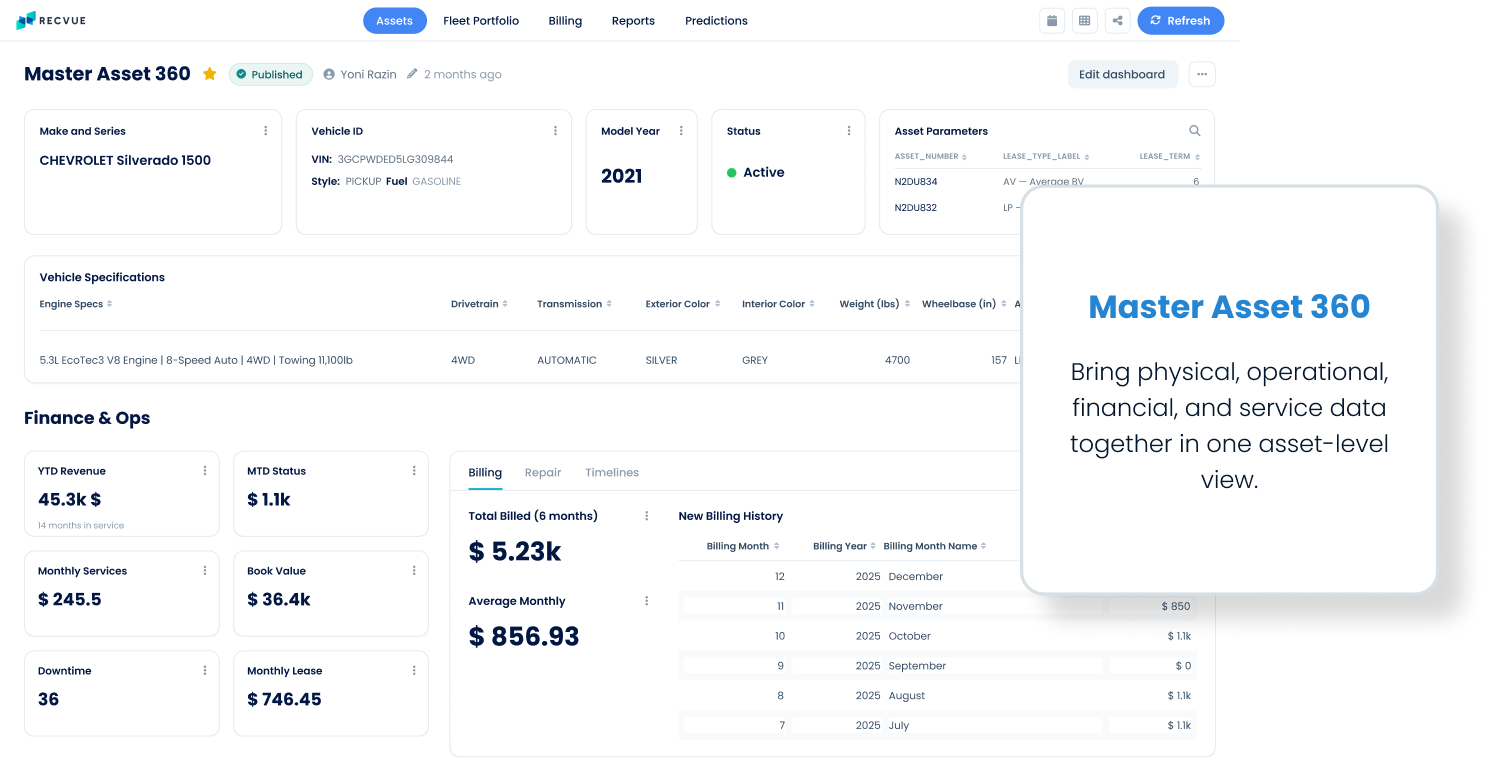
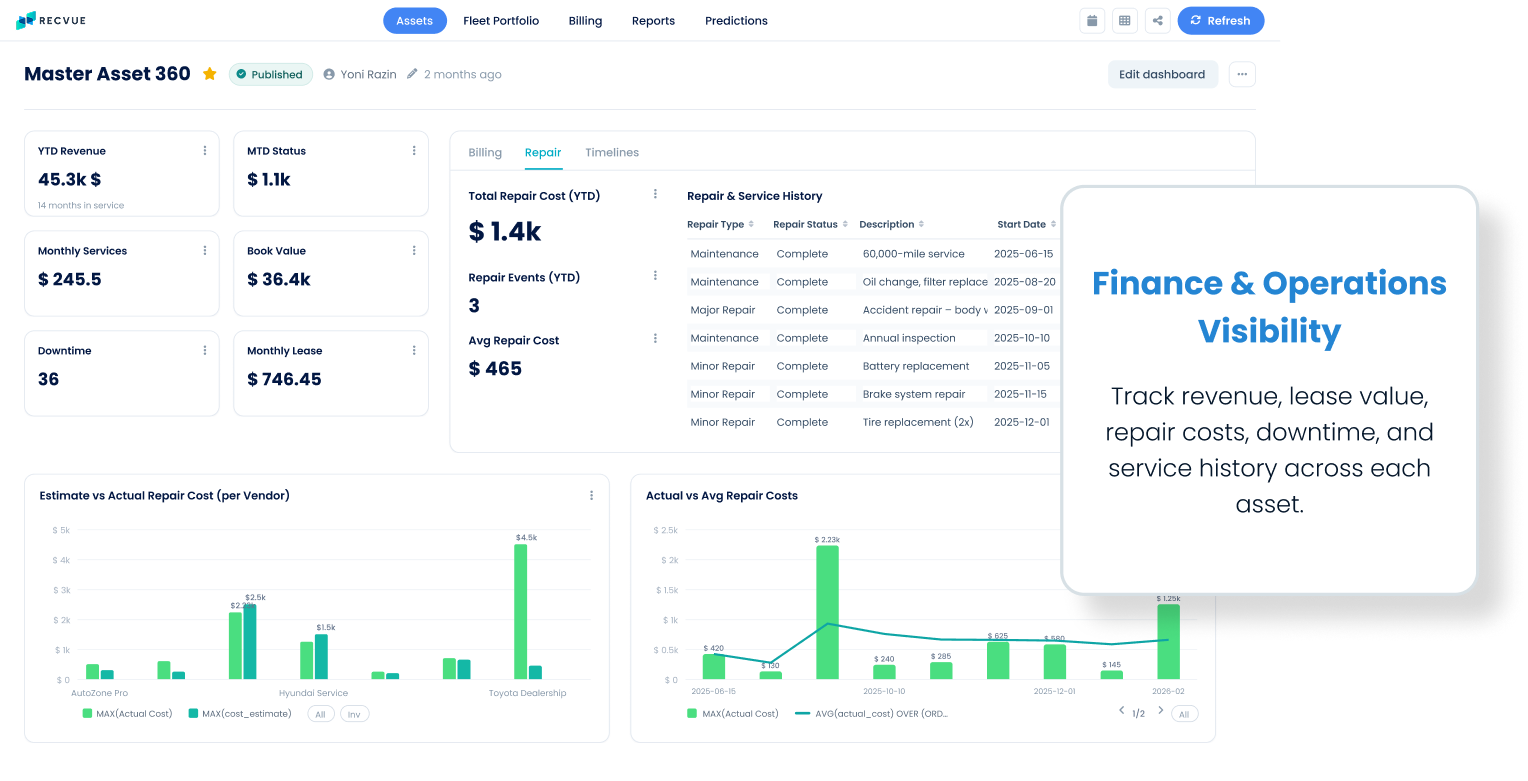
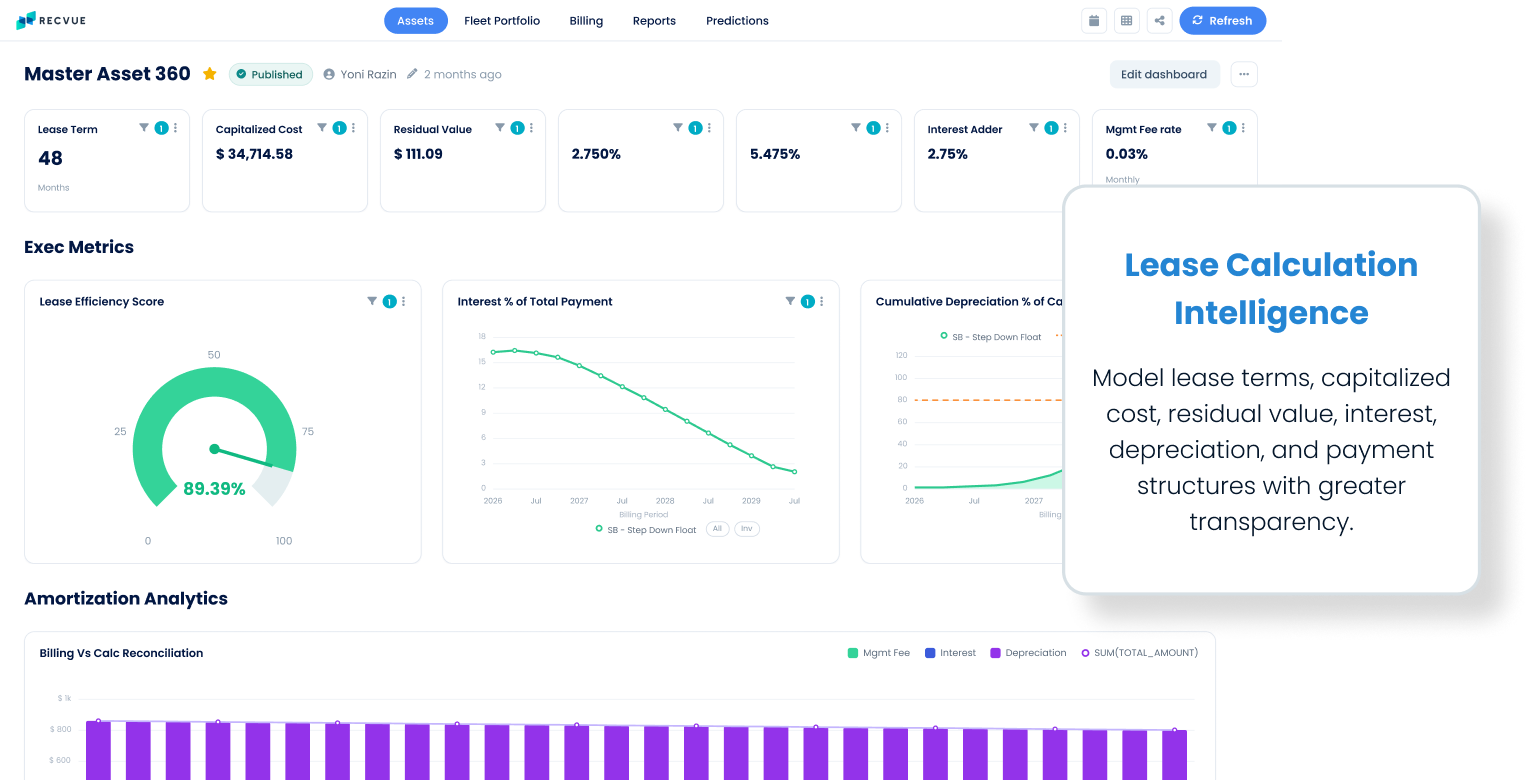
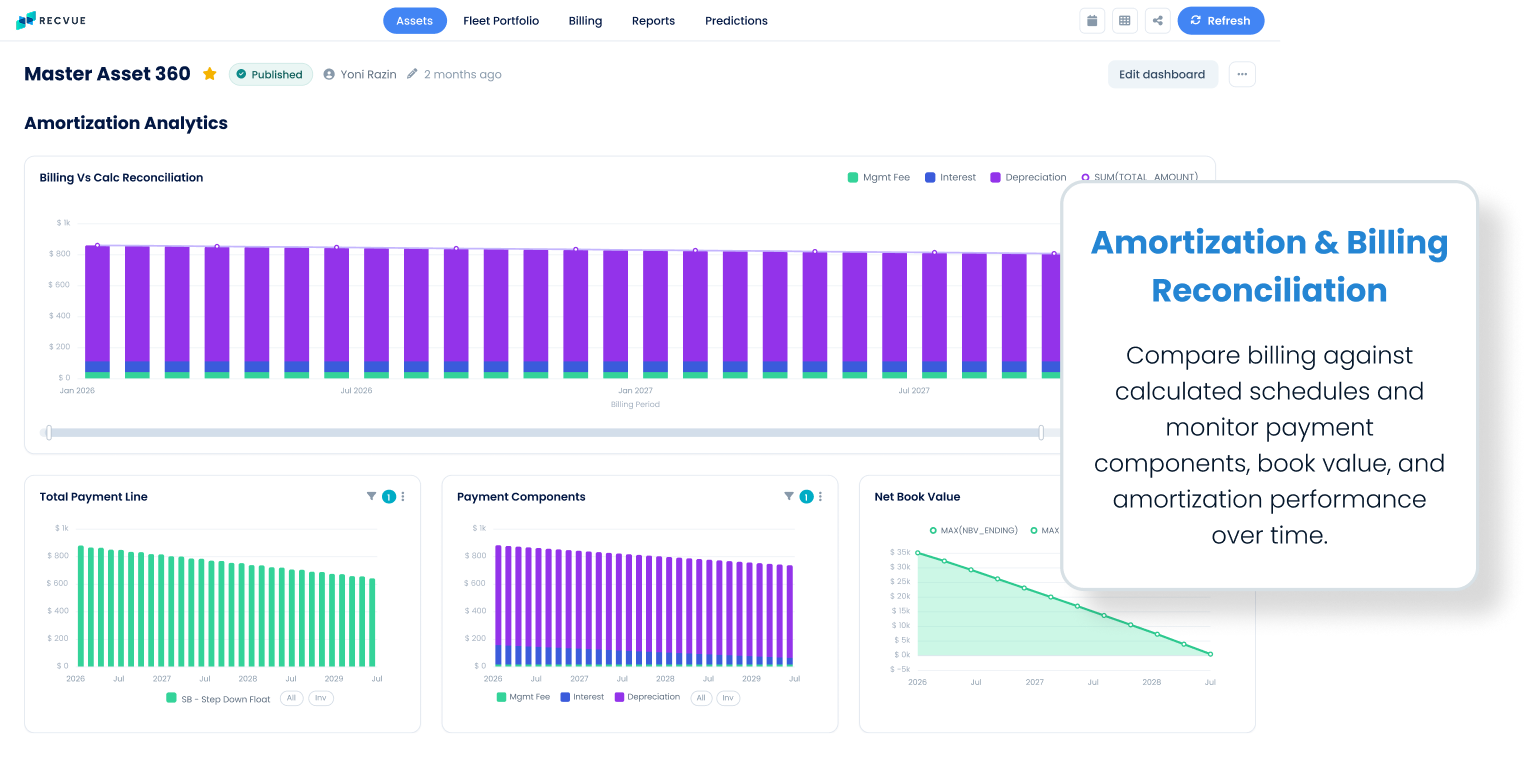
Complete Asset-to-Cash Intelligence for Transportation & Logistics
Connect every asset, contract, lease, service event, and billing stream in one intelligent operating view.
RecVue helps transportation and logistics companies manage complex asset-based revenue models by unifying fleet, lease, billing, maintenance, and financial data. From asset-level performance and repair history to lease calculations, amortization schedules, and billing reconciliation, RecVue gives finance and operations teams the visibility they need to improve revenue accuracy, reduce manual effort, and make better decisions across the asset lifecycle.
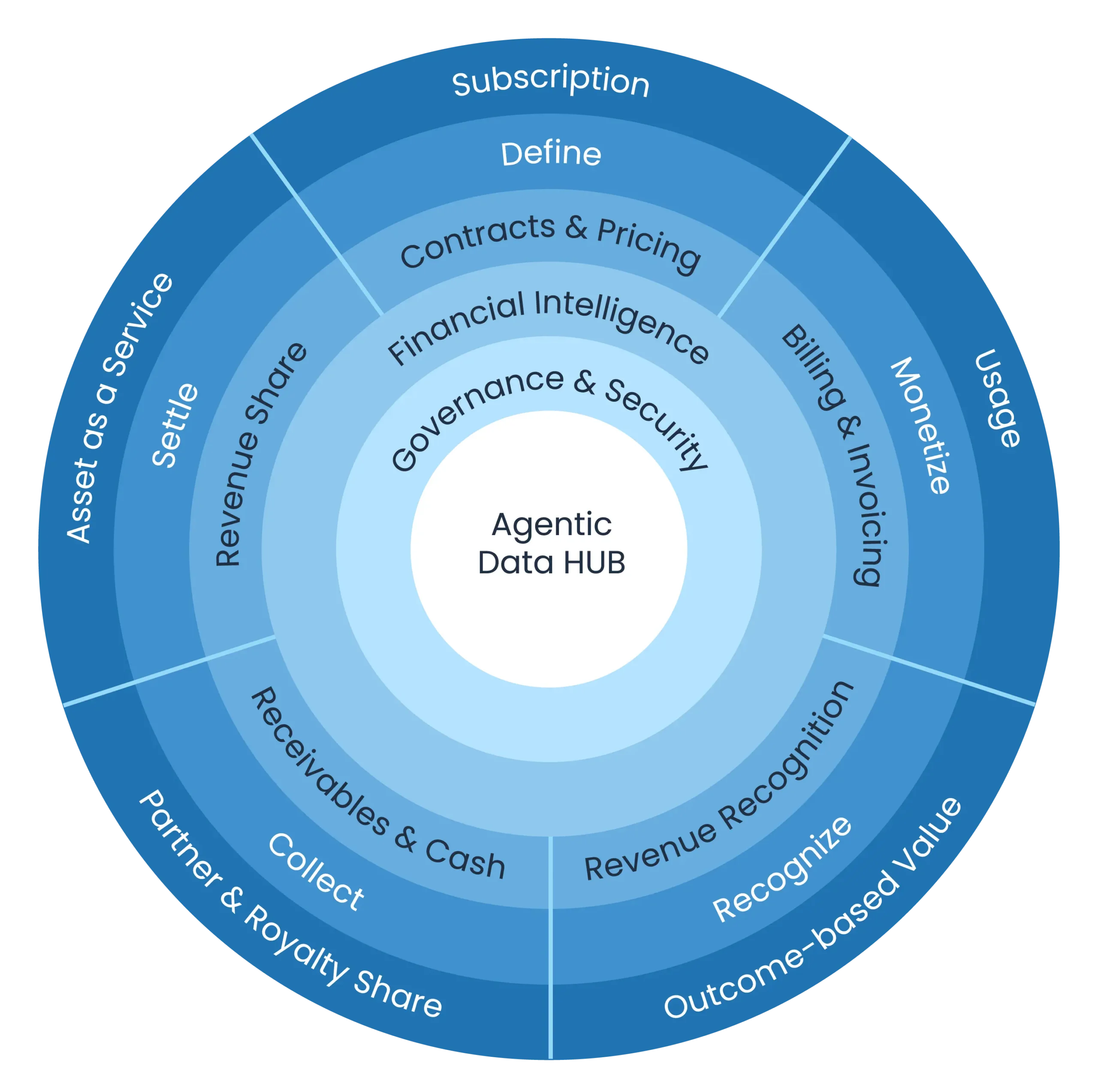
The Agentic Revenue Operating System Built for Transportation & Logistics Complexity
RecVue RevOS unifies complex transportation and logistics revenue and cash operations onto a single, intelligent platform. Built on an Agentic Data Hub, it connects contracts, ratings, billing, revenue recognition, collections, and partner settlements, bringing enterprise-grade governance and control to high-volume, multi-party logistics environments.
From Shipment to Settlement Without Revenue Leakage
Learn More
"RecVue experience"
"Great product with great people"





 Schedule a meeting
 Request a Demo