






 Diagnostics







Every sale your business makes kicks off a sequence of events that ideally ends with cash in the bank. That sequence is the order-to-cash cycle (O2C), and how well you manage it directly impacts cash flow, operational efficiency, and customer relationships.
What is the order-to-cash cycle?
O2C is the process that begins when a customer places an order and ends when payment is collected and recorded. It’s not just invoicing or collections, but everything in between: order validation, credit checks, fulfillment, billing, and cash application.
Think of it as the operational backbone of revenue realization. A sale isn’t revenue until cash changes hands, and the O2C cycle is the path that gets you there.
Critically, the cycle connects three functions that don’t always work in lockstep: sales, finance, and operations. When those teams are aligned and supported by the right systems, O2C runs smoothly. When they’re siloed, cracks show up as disputes, delays, and aging receivables.
Importance and benefits of order-to-cash
An efficient O2C cycle directly affects your company’s financial health.
Improved liquidity and working capital. The faster you move from order to cash, the more working capital you have available. A sluggish cycle ties up money in receivables that could be deployed elsewhere.
More accurate forecasting. When the process is consistent and well-documented, finance teams have greater visibility and can predict cash inflows with confidence. When it’s messy, cash flow forecasting becomes little more than guesswork.
Better customer experience. A botched invoice or a delayed shipment isn’t just an operational problem, it’s a customer experience problem. Clean, accurate billing and timely delivery build trust.
Greater cost efficiency. Every manual touchpoint, rework cycle, and dispute resolution is overhead. Tightening O2C lowers the cost of doing business.
Order-to-cash process steps
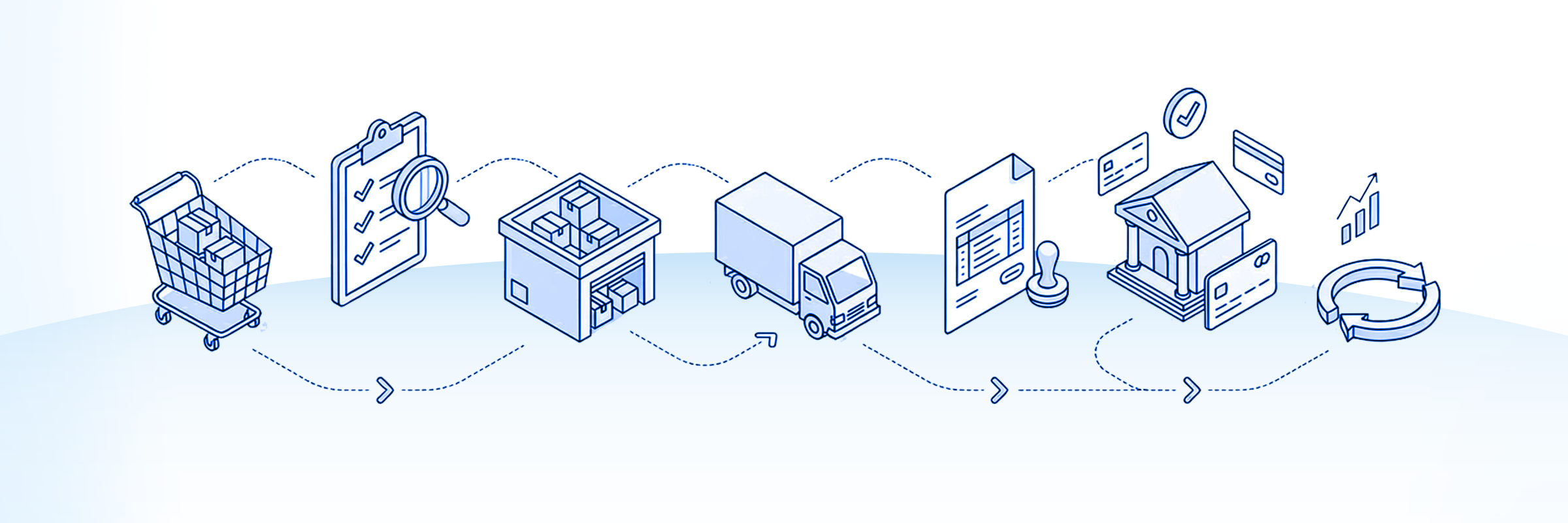
The O2C cycle typically runs through five core stages. Specifics vary by industry and business model, but the logic holds.
Step 1: Order capture and validation
The cycle starts when a customer submits an order. Before anything moves forward, that order needs to be validated. Is the pricing correct? Does the configuration make sense? Is the product available? Errors caught here are cheap and quick to fix.
Step 2: Credit check and approval
Before extending credit or releasing an order for fulfillment, most organizations run some form of credit assessment. This step evaluates payment history, credit limits, and financial risk. A strong credit check process protects against bad debt while keeping legitimate orders flowing.
Step 3: Order fulfillment
This is where the product or service is actually delivered. For physical goods, it means picking, packing, and shipping with logistics in the loop. For services, it may mean scheduling resources and kicking off project delivery. For SaaS, it might be provisioning access. Fulfillment is where coordination between sales, ops, and finance is most critical—and where delays compound.
Step 4: Invoicing and billing
Once the order is fulfilled, an invoice is generated and sent to the customer. It sounds simple, but with today’s hybrid monetization models, this is where many O2C cycles break down.
Billing complexity, tiered pricing, usage-based models, multi-element arrangements, and contract amendments increase the risk of inaccuracy. And an inaccurate invoice doesn’t just delay payment; it creates disputes, damages relationships, and requires costly rework.
Step 5: Payment collection and reconciliation
The final step is collecting payment and applying it to the right accounts. This includes monitoring aging receivables, following up on overdue balances, processing payments, and reconciling the books. Effective cash application—matching payments to open invoices accurately and quickly—closes the loop and completes the cycle.
Key KPIs in order-to-cash
You can’t manage what you can’t measure. These metrics tell you how your O2C cycle is performing.
Days sales outstanding (DSO). DSO measures the average number of days it takes to collect payment after a sale, and obviously, lower is better. High DSO signals collection delays, billing problems, or credit risk exposure.
Invoice accuracy rate. What percentage of your invoices are issued without errors or disputes? Low accuracy rates are a leading indicator of collection problems and a signal that your billing process needs attention.
Order cycle time. Tracking how long it takes from order receipt to fulfillment and invoicing is critical. Long cycle times often indicate manual bottlenecks or systems that don’t talk to each other.
Collection effectiveness index (CEI). CEI gives you a more nuanced take on collections performance than DSO alone. It measures how effectively your AR team collects on receivables during a given period, relative to what was available to collect.
Bad debt ratio. Examine the percentage of receivables that go uncollected. Rising bad debt often points to credit control problems upstream in the cycle.
Tracking these metrics together gives you a full picture of where the cycle is healthy and where it’s losing time or money.
Common challenges in the order-to-cash cycle
Most O2C problems aren’t unique. They show up across industries, business models, and company sizes. Here are the most damaging.
Manual, disconnected workflows. When order data lives in one system, fulfillment in another, and billing in a third, handoffs become failure points. The human in the middle becomes a problematic bottleneck.
Billing complexity. Modern pricing is genuinely hard to automate without purpose-built tools. Spreadsheet-based billing doesn’t scale, and the errors directly inflate DSO.
Weak credit controls. Approving orders for high-risk customers, or skipping credit checks entirely under sales pressure, is how bad debt happens. Strong credit policies applied consistently upstream protect the entire cycle.
Limited visibility. Without real-time data across the cycle, finance leaders often react to problems rather than anticipate them. Aging receivables go unnoticed. Disputes escalate. Forecasts miss.
Disputed invoices. Every disputed invoice freezes cash and slows working capital. Disputes usually trace back to earlier in the cycle, such as a pricing error, a missed delivery milestone, or a contract term that wasn’t reflected in billing.
How automation improves the order-to-cash cycle
Manual processes are the enemy of a high-performing O2C cycle. Order-to-cash process automation addresses the root causes of most cycle failures.
When order data flows automatically into billing, invoices reflect what was actually delivered, under the terms of the actual contract. When payment data feeds directly into reconciliation workflows, cash application happens faster and with fewer errors. When collections teams get automated alerts on aging invoices, follow-up is timely and consistent.
The goal isn’t to remove human judgment from the process—it’s to eliminate the manual work that slows things down and introduces errors. Finance teams that have automated core O2C workflows report lower DSO, higher invoice accuracy rates, and lower collections costs.
For organizations with complex hybrid billing models, purpose-built order-to-cash solutions are often the difference between a process that scales and one that breaks under its own weight.
Best practices for optimizing order-to-cash
If you’re looking to improve your O2C cycle, these levers will actually move the needle.
- Standardize your workflows. Ad hoc processes produce ad hoc results. Documented, consistent workflows—from order validation through cash application—reduce variability and make it easier to spot problems early.
- Define and enforce credit policies. Clear credit limits, consistent review processes, and defined escalation paths protect revenue without slowing down legitimate business. The goal is speed with appropriate risk controls, not a rubber stamp.
- Automate invoicing tied to contract terms. Billing accuracy depends on billing systems that actually know what was agreed. When invoices are generated from contract and delivery data automatically, error rates drop dramatically.
- Track KPIs consistently. DSO and invoice accuracy vary across the business cycle. Regular, consistent measurement, ideally in real time, lets you identify trends before they become problems.
- Communicate proactively with customers. Don’t wait for invoices to become overdue to initiate contact. Automated payment reminders, clear invoice presentation, and easy dispute resolution pathways all reduce friction and speed up collection.
Order-to-cash for different business types
The O2C cycle follows the same general logic across industries, but the specifics look different depending on the business model. Here are a few key variations.
SaaS and subscription businesses deal with recurring billing, free trial conversions, mid-cycle upgrades, and usage overages. The challenge is accurately billing for what was consumed under the terms of each contract—a problem that scales rapidly as the customer base grows.
Manufacturing companies must coordinate inventory availability, production schedules, shipping logistics, and freight billing. Order cycle time is often longer, and the cost of errors at the invoicing stage is high.
Professional services firms often bill against milestones, time-and-materials arrangements, or retainer agreements. Revenue recognition is closely tied to delivery, and accurate tracking of completed work is essential for correct billing.
Complex, multi-entity operations common in telecom, transportation, and logistics face intercompany billing challenges, multiple currencies, diverse contract structures, and the need for consolidated revenue recognition across entities.
How order-to-cash compares to related financial processes
O2C is one of several core financial workflows, and understanding how it fits with the others clarifies where it starts and stops.
Procure-to-pay (P2P) is O2C’s counterpart on the cost side—managing the process from purchase requisition through vendor payment. Where O2C focuses on revenue collection, P2P focuses on expenditure control.
Record-to-report (R2R) covers financial close and reporting. It consumes data from O2C (and P2P) to produce financial statements, perform reconciliations, and support audit and compliance. O2C feeds R2R; the two aren’t the same process.
Together, these three cycles—O2C, P2P and R2R—form finance’s operational backbone.
Frequently asked questions
What is the order-to-cash cycle in simple terms?
O2C is the process your business follows from the moment a customer places an order to the moment payment is collected. Every step in between—validation, credit approval, fulfillment, invoicing, and collections—is part of the cycle.
Why is the order-to-cash process important?
O2C directly determines how fast revenue turns into cash. A slow or error-prone O2C cycle means delayed collections, higher DSO, more disputes, and weaker working capital. A well-run cycle improves liquidity, supports accurate forecasting, and reduces operational costs.
What are common issues in the order-to-cash cycle?
The most common problems in a traditional O2C cycle are manual workflows that introduce errors and delays, disconnected systems that force data re-keying, inaccurate billing that leads to disputes, weak credit controls that increase bad-debt risk, and limited visibility into cycle performance.
How can businesses improve their order-to-cash process?
Improving O2C starts with measurement. If you don’t know your DSO and invoice accuracy rate, you’re flying blind. Then look at where handoffs between systems or teams are breaking down. In most cases, the biggest gains come from automating billing and invoicing tied directly to contract terms and delivery data.
An O2C cycle for fast cash
From the moment a customer places an order to the moment payment clears, every O2C step either accelerates or impedes cash flow. Organizations that manage it well with standardized processes, accurate billing, and real-time visibility have a structural advantage over those that don’t.
About the Author