


 Diagnostics



Detention and demurrage get lumped together on invoices, in emails and in hallway conversations. But they aren’t the same charge. Each has its own trigger, its own clock and often its own payer. Confusing the two is one of the fastest ways to pay fees you could have avoided or miss fees you should have billed.
The stakes aren’t small. The nine largest ocean carriers reporting to the Federal Maritime Commission collected roughly $15.4 billion in detention and demurrage between April 2020 and March 2025.
This guide breaks down what each charge means, how free time and the math work, and what finance and logistics teams can do to stop these costs from quietly eroding margin.
Understanding detention charges
Detention kicks in when equipment someone else owns such as a truck, trailer or container is held longer than the agreement allows.
What is detention and how it works
In trucking, detention applies when a carrier’s driver and truck wait at a shipper or consignee’s facility beyond the agreed free time, often two hours for loading or unloading. After that window closes, the carrier bills an hourly rate for the lost time.
In ocean freight, detention covers a container kept outside the port or terminal beyond its free days. The FMC describes it as a charge for extended use of intermodal equipment. The clock typically starts when the container gates out and stops when the empty is returned.
Either way, the logic is the same. The equipment owner loses money every hour its asset sits idle at someone else’s dock, and detention is how it recovers that cost.
Per diem charges and how they relate to detention
Per diem is a daily fee container owners, usually ocean carriers, charge for equipment used outside the terminal. In U.S. intermodal practice, carriers often bill per diem to the trucking company under its equipment interchange agreement, while they bill detention to the shipper or consignee under the carrier’s tariff or service contract.
The line between the two is blurry, and many carriers use the terms interchangeably. The FMC’s billing rule folds per diem into its definition of detention and demurrage charges. The practical takeaway: check the contract to see which charge you’re being billed, who’s billing it and whether it’s being passed through to you a second time.
Common examples of detention charges
- The shipment isn’t ready. A driver arrives for a 9 a.m. pickup, but the freight isn’t staged. Loading wraps at 1 p.m., two hours past free time, and the carrier bills two hours of detention.
- The dock is backed up. A warehouse short on labor during peak season leaves inbound trucks waiting in the yard for hours.
- The container can’t be unloaded. An importer picks up a container, but its warehouse can’t devan it for a week, pushing the empty return past free days.
- The booking rolls. An exporter loads a container, but the vessel booking moves to a later sailing and the loaded box sits at the facility.
Understanding demurrage charges
If detention follows equipment out of the terminal, demurrage is about what happens before it ever leaves. It’s a charge for occupying space that someone else needs.
What is demurrage and how it works
Demurrage applies when a container stays at a port, terminal or rail facility beyond its allotted free time without being picked up. The FMC puts it simply: demurrage accrues when a container exceeds free time on a marine terminal.
For imports, the clock usually starts when the container is discharged and available for pickup. It runs until the container gates out. Terminals and carriers use demurrage to keep yards moving, because every idle box takes up space another shipment can’t use.
Common examples of demurrage charges
- Customs holds. An exam or documentation hold keeps an import container at the terminal for six days when only four are free.
- Release problems. Freight charges haven’t been paid or release documents are missing, so the carrier won’t release the cargo.
- No truck, no appointment. During a congestion spike, terminal appointments and drayage capacity dry up and containers wait.
- Inland rail delays. A container reaches an inland rail yard on time, but no dray is booked to collect it before free time ends.
- Early export arrivals. An exporter delivers a loaded container to the terminal days before the vessel’s receiving window opens.
Detention vs. demurrage: Key differences explained
The simplest way to keep them straight is demurrage is about cargo sitting inside the terminal, and detention is about equipment held outside it. Both can hit the same container, one after the other.
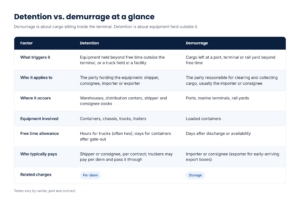
Free time: What it is and how it works
Every detention and demurrage charge starts the moment free time ends. Free time is the window a carrier, terminal or trucking company grants at no cost, and it varies by carrier, port, trade lane, equipment type and contract. Treat it as a budget, because that’s exactly what it is.
When the clocks start. The demurrage clock usually starts when an import container is discharged and available at the terminal. The detention clock starts when the container gates out and stops when the empty is returned. For exports, detention generally runs from empty pickup to loaded return.
How free time is structured. Some contracts grant separate free demurrage days and container detention free time. Others offer combined free time, a single pool that covers both. Under 10 combined days, a container that sits seven days at the terminal leaves only three for unloading and returning the empty.
What eats into it. Port congestion, customs exams, documentation holds and appointment shortages all burn free days, often for reasons the shipper can’t control. That’s why free time on paper rarely matches free time in practice.
Negotiating more. Free time is a commercial term like any other. Shippers with steady volume can often negotiate extended free time in service contracts, especially on lanes with chronic congestion. That makes it as much a contracts and pricing conversation as an operations one.
How detention and demurrage charges are calculated
The math is simple. The exposure isn’t. Once free time ends, a daily rate applies per container (or an hourly rate for truck detention). Most carriers use escalating tiers, so each additional day costs more than the last. Rates come from the carrier’s published tariff or a negotiated service contract.
Here’s a hypothetical example. A 40-foot import container gets four free demurrage days and four free detention days. A customs hold keeps it at the terminal for 10 days, and the empty is returned seven days after gate-out.
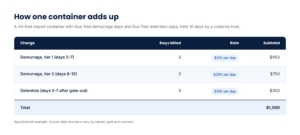
That’s one box. Multiply it across a 20-container shipment and a single customs hold becomes a $30,000 problem. Charges also compound because delays cascade. A late pickup leads to a late unload, which leads to a late return, which stacks detention on top of demurrage for the same container.
Storage charges and when they apply
The terminal operator typically charges storage rather than the ocean carrier for the space cargo occupies after terminal free time. At some ports, demurrage covers it. At others, storage shows up as a separate line alongside demurrage, and rail yards and warehouses often bill it too. When both appear for the same container and dates, confirm whether that’s legitimate under your contract or a duplicate worth disputing.
Common causes of detention and demurrage charges
Congestion gets the headlines, but most avoidable charges trace back to a short list of internal failures.
- Scheduling and coordination gaps. Drayage isn’t booked before the last free day, terminal appointments are missed, or empties sit at the warehouse because no one scheduled the return.
- Documentation errors. An incorrect commercial invoice, a missing filing or unpaid freight can stall customs clearance or port release while free days tick away.
- Congestion and facility constraints. Labor shortages, chassis shortages and limited dock doors slow pickups, unloading and returns.
- Poor communication. The consignee doesn’t know a container is available, or the carrier doesn’t know a facility can’t receive it until the truck is already waiting.
The business impact of unmanaged charges
Detention and demurrage rarely show up in a budget, which is exactly why they do so much damage.
Financial. These charges hit margin directly and often arrive well after a shipment has closed. U.S. rules give ocean carriers and terminals up to 30 calendar days after charges stop accruing to send an invoice. That lag distorts landed cost, complicates accruals and ties up cash in disputes.
Operational. Containers waiting at terminals mean inventory that isn’t on shelves. Rushed pickups to beat the clock create unloading backlogs that push other shipments past their own free time.
Relationships. Customers who absorb pass-through charges notice. Constant disputes strain relationships with shipping lines, and companies that can’t predict these costs end up padding their pricing to cover them, making them less competitive.
There’s a flip side, too. For carriers and logistics providers, detention that’s earned but never billed — or billed late or inaccurately — is revenue leakage. Like other accessorial charges, it’s easy to lose in manual processes.
How to avoid or reduce detention and demurrage charges
You can’t control port congestion. You can control how prepared you are.
Plan around free time. Track the last free day for every container and prioritize pickups by it. Book drayage before the vessel arrives, return empties as soon as they’re unloaded, and watch port and rail conditions so you can shift plans before a backlog hits.
Get documents right the first time. Work with your customs broker before cargo arrives, not after a hold. Confirm commercial invoices, filings and release documents are complete, and pay freight early so nothing blocks release.
Close the communication gaps. Share ETAs, availability and last free days across brokers, carriers, drivers, shippers and consignees. Set dock appointments and escalate early when a facility can’t receive on time.
Audit every invoice. Check charges against contracted free time and rates, and compare billed dates to actual gate events. Under the FMC’s billing rule, an ocean detention or demurrage invoice missing required information eliminates the obligation to pay that charge.
Tools and services for managing charges
Spreadsheets and inbox searches can’t keep up with hundreds of containers and dozens of contracts. The right tools turn free time from something you discover too late into something you manage.
- Freight visibility platforms track container milestones and send alerts as the last free day approaches, so teams act before charges start.
- Demurrage management software and third-party audit services compare invoices to contracts and gate events, flag errors and help build disputes.
- TMS integrations consolidate detention, demurrage, storage and per diem across carriers into one view, so finance can see true landed cost by lane, customer or supplier.
For carriers, 3PLs and other logistics providers, the challenge flips. The goal isn’t to avoid these charges, but to capture every one earned and bill it accurately and on time. That requires contract terms, free time rules and tiered rates connected directly to the event data that triggers them. RecVue’s transportation and logistics solutions help providers automate that path from contract to invoice, so billable detention doesn’t slip through the cracks.
Conclusion
Detention and demurrage are distinct charges with different triggers, clocks and payers, but they share one trait: left unmanaged, they get expensive fast. Most of that cost is avoidable with better free time terms, tighter scheduling and real visibility into where every container stands.
Start by asking three questions. Where could you negotiate more free time? Which scheduling or documentation gaps keep burning free days? And do your finance and operations teams see the same data on charges, contracts and invoices? The answers will show you exactly where you’re losing money and where to win it back.
Frequently asked questions
Who pays detention and demurrage charges?
It depends on the contract and shipping terms. Demurrage on imports usually falls to the importer or consignee, while detention falls to whoever holds the equipment past free time. For ocean shipments into the U.S., FMC rules limit invoices to the party that contracted for the transportation or the consignee, not both.
Can shippers dispute detention and demurrage charges?
Yes. Under the FMC’s billing rule, billed parties get at least 30 calendar days to request a waiver, refund or reduction, and the billing party must attempt to resolve it within 30 days. Back up a dispute with gate timestamps, appointment records and proof of holds outside your control.
What happens when free time expires on a shipment?
Daily charges usually begin at escalating rates and keep accruing until the container is picked up or returned. Carriers may also require payment before releasing cargo, which can further delay the shipment.
Do detention and demurrage charges apply to domestic shipments?
Yes. Truck detention at shipper and receiver docks is common in domestic freight, and rail carriers charge demurrage when cars or containers sit beyond free time.
How can companies track detention and demurrage exposure?
Track the last free day for every container, use visibility tools that alert before free time ends and consolidate charges by carrier, lane and customer. Then reconcile invoices against contracted terms so finance sees what was billed and what should have been.
About the Author