


 Diagnostics



Two brokerages move the same load for the same shipper at the same $3,000 rate. One reports $3,000 in revenue. The other reports $450. Neither is necessarily wrong, and that’s exactly the problem.
For 3PLs and freight brokers, the principal vs. agent question decides whether the top line reflects the full amount billed or only the fee you keep. It shapes gross margin percentages, lender covenants, valuation conversations and the story your board hears every quarter. And under ASC 606, the answer doesn’t come from the contract’s title, your broker license or who sends the invoice. It comes from one thing: who controls the service before it reaches the customer.
This blog walks finance and accounting teams through how to make that call, document it and defend it.
Understanding principal vs. agent in freight and logistics
Almost every freight transaction involves at least three parties: the shipper, the carrier and the intermediary. When another party is involved in providing a service to your customer, ASC 606 requires you to decide whether your promise is to provide that service yourself (principal) or to arrange for someone else to provide it (agent).
That decision isn’t made once per customer or once per contract. Since ASU 2016-08, the unit of account is each specified good or service. A single master service agreement can make you a principal for one service and an agent for another.
What is a principal in a freight transaction
A principal controls the transportation service before it’s transferred to the shipper. That doesn’t require owning a single truck. ASC 606 explicitly allows a principal to satisfy its obligation by engaging another party, such as a subcontracted carrier, to perform some or all of the work on its behalf.
In freight, the principal role typically shows up in asset-light truckload brokerage where the 3PL commits to move the load at an all-in rate, in contract logistics and in integrated 3PL programs where the provider owns the outcome from pickup to proof of delivery.
What is an agent in a freight transaction
An agent arranges for another party to provide the service but never controls that service itself. Its revenue is the fee or commission it earns for making the arrangement.
Agent roles often appear in customs brokerage, where the provider files entries on an importer’s behalf and passes duties through.They also show up in fee-based managed transportation, where the shipper holds the carrier contracts and pays the 3PL a per-load or per-shipment management fee. Still, no service line is an agent by default. Classification always depends on the facts of each arrangement.
Key differences between principals and agents in freight brokerage
The labels sound simple, but in practice the line between them runs through how you work with shippers and carriers every day. Here’s how the two roles typically compare.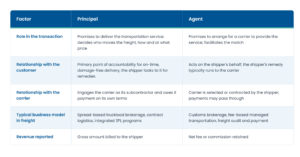
Legal and financial duties of principals and agents
Contracts say one thing but operations sometimes say another. When the two drift apart, the duties each party carries, and the revenue it reports, follow what actually happens on the road.
- Legal agreements set rights and control over the service. Your master service agreement and broker-carrier agreements define who can select carriers, reassign loads and set rates. But if the MSA says you act “as agent for the shipper” while your team picks every carrier, re-tenders rejected loads and absorbs claims, the operational reality tells a different story.
- Fiduciary duty and restricted funds apply when acting on a customer’s behalf. Customs duties, pass-through freight payments and similar funds may need to be held, segregated and reconciled separately from operating cash. The FMCSA has said that handling money between shippers and carriers is a strong signal that broker authority is required.
- Risk, compliance and remedies land on the party the customer can hold accountable. When a load arrives late or damaged, who does the shipper call? Whoever absorbs claims, service credits and chargebacks is carrying risk that looks a lot like a principal’s.
- Legal agency isn’t the same as accounting agency. A legal agency relationship brings fiduciary obligations. ASC 606’s assessment, by contrast, is about control. Federal law even defines a broker as someone who arranges transportation “as a principal or agent,” so the regulatory label doesn’t settle the accounting question.
- The role you’re assigned shapes every report downstream. Gross vs. net treatment changes the top line, gross margin percentage, revenue-based covenants, sales compensation plans and the KPIs your board tracks. Net income usually stays the same, but almost everything people look at first doesn’t.
Principal vs. agent assessment framework
ASC 606 gives you a two-step test, supported by a set of indicators. Here’s how a 3PL or broker works through it.
Identifying the service provided to the customer
Start with what the shipper is actually buying. Is it the movement of freight from origin to destination? Or is it the service of finding and booking a carrier?
The contract and the pricing usually tell you. An all-in rate per load with a delivery commitment points to the transportation itself. A fixed per-shipment fee for tendering loads to the shipper’s own routing guide points to the arrangement.
When one contract covers several services, such as linehaul, warehousing, drayage, customs clearance and accessorial charges, identify each distinct service and assess it separately.
Evaluating control before the service is transferred
Control is the deciding factor. For a service, control means you can direct the other party, typically the carrier, to perform the service on your behalf.
Freight is consumed as it moves, so you can’t “hold” it the way a distributor holds inventory. The practical questions are about direction. Can you choose the carrier? Can you pull a load and re-tender it? Do you set the routing and service requirements? If the shipper makes those calls, you likely don’t control the service.
Key indicators for classification
The indicators in ASC 606-10-55-39 support the control assessment. They aren’t a scorecard, and SEC staff have cautioned against treating them as a checklist.
- Primary responsibility for fulfillment. Who is responsible to the shipper for the load arriving on time and intact, including making it right when it doesn’t?
- Inventory risk. In freight, this usually looks like capacity risk. Committing to dedicated capacity, contracted lanes or pre-purchased ocean and air space before you have a customer order is a strong principal signal.
- Pricing discretion. Do you set the shipper’s rate independently of what you pay the carrier? This one matters, but it rarely decides the question alone, since agents sometimes influence pricing too.
Note what’s no longer on the list. ASU 2016-08 removed credit risk and commission-based pay as indicators, so carrying receivable risk or being paid a percentage doesn’t decide anything on its own.
How principal vs. agent status affects revenue recognition
The classification determines whether revenue equals the full amount billed or only the fee you retain. Take a load billed to the shipper at $3,000, with $2,550 paid to the carrier.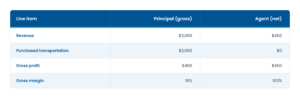 In this example, the same load, same profit, but very different-looking income statements.
When to report revenue gross
If you control the transportation service before it’s transferred to the shipper, you’re the principal. You recognize revenue at the gross amount you expect to be entitled to, and record the carrier’s charge as a cost of purchased transportation. This is the typical treatment for brokers that own the shipper relationship, select and direct carriers and stand behind delivery.
When to report revenue net
If you’re arranging the service and the shipper effectively controls it, you’re the agent. You recognize only your fee or commission, even if the full freight payment flows through your bank account. Under the IFRS 15 framework, which mirrors ASC 606 here, an agent recognizes the net amount regardless of whether gross cash passes through.
Because the gap between the two methods can be so large, many logistics companies supplement GAAP revenue with a non-GAAP net revenue or adjusted gross profit measure. If you do, make sure the reconciliation is clear and consistent.
Examples and scenarios for 3PLs and freight brokers
The same framework can lead to different conclusions, even within one customer relationship. These examples show how the assessment can play out.
Two brokers, two arrangements
Broker A promises to move a shipper’s load for an all-in rate. It selects a carrier from its own network to perform the move on its behalf. If the carrier falls off, Broker A finds a replacement and remains responsible for getting the load delivered.
The specified service is transportation. Broker A controls that service before it is transferred to the shipper, so it acts as principal.
Broker B works in a shipper’s transportation management system, tendering loads to carriers under the shipper’s own agreements. The shipper selects the carriers and sets the contracted rates. Broker B’s role is to manage the tendering process for a per-load fee.
The service being assessed is the transportation provided by the carrier. Broker B arranges that service but does not control it before it reaches the shipper, so it acts as agent.
One 3PL, multiple services
A 3PL signs one contract covering warehousing, outbound distribution and customs-related services. The arrangement includes distinct services, each with its own facts:
- Warehousing: The 3PL runs and staffs the facility. It provides the warehousing service directly and acts as principal for that service.
- Outbound distribution: The 3PL promises to move the freight and engages carriers to perform the transportation on its behalf. It controls the transportation service before transfer and acts as principal.
- Customs-related services: The 3PL files entries for the importer and pays duties on its behalf. If it also arranges a distinct service provided by another party without controlling that service first, it acts as agent for that service. Paying duties or filing entries alone does not settle the classification.
One contract can therefore contain different principal and agent conclusions. Each conclusion depends on the particular service and arrangement.
One shipper, different treatment by load
A managed transportation provider handles two loads for the same shipper.
For the first load, the provider tenders freight to a carrier under the shipper’s agreement. The shipper selects the carrier, and the provider’s role is to arrange the move. The provider acts as agent for that transportation service.
For the second load, the shipper needs overflow capacity. The provider promises to move the load, obtains capacity in its own name and directs a carrier to perform the move on its behalf. In this arrangement, the provider controls the transportation service before transfer and acts as principal.
The customer is the same, but the provider’s role differs because the arrangements differ.
A combined service using a subcontractor
A 3PL contracts to provide an integrated warehousing and distribution service. It controls the warehouse operation and engages a carrier to move goods as part of that combined service. The customer has contracted for the integrated output, rather than separate warehousing and transportation services.
If the 3PL controls the inputs and directs their use to deliver that combined service, it acts as principal for the combined offering, even though a subcontracted carrier performs part of the work.
Common misconceptions about principal vs. agent classification
Most gross vs. net errors don’t come from misreading the standard. They come from assumptions that feel right but aren’t.
- “A freight broker license means we’re always an agent.” Not so. The federal definition of a broker explicitly covers parties acting as a principal or an agent, and many of the largest public brokers report truckload brokerage revenue gross. Your FMCSA authority describes your regulatory status, not your accounting role.
- “We invoice the customer directly, so we’re the principal.” Billing mechanics aren’t control. Agents collect and remit funds all the time.
- “Gross reporting is the safer default.” Overstated revenue is still a misstatement. Principal vs. agent conclusions have been a recurring focus of SEC staff comment letters under both legacy GAAP and ASC 606.
- “One classification applies to every service line.” The assessment is made for each specified service. Brokerage, warehousing, customs and managed transportation can and often do land in different places.
- “Net reporting means lower profit.” It doesn’t. Gross profit and net income are generally the same either way. What changes is the size of the top line and the margin percentage.
Best practices for principal vs. agent assessments
A defensible conclusion under ASC 606 and ASU 2016-08 is one you can explain the same way every time, to anyone who asks. These practices will help get you there.
Apply a documented assessment framework to all specified goods and services.
Use the same two-step test and the same indicator analysis for every service line, so similar arrangements reach similar answers.
Run a contract review process that checks contract language and the scope of agent responsibilities.
Flag terms that shift control, such as carrier selection rights, rate-setting authority, claims liability and payment obligations.
Use professional judgment on each multi-party arrangement and record the reasoning.
A short memo explaining why the indicators point where they do is worth far more than a checked box.
Schedule regular evaluations as contracts and operations change.
A new customer program, a shift to dedicated capacity or a change in who manages the routing guide can flip a conclusion.
Keep finance, operations and legal aligned on each conclusion.
Accounting can only reflect what operations actually does. If the three teams aren’t talking, the classification will drift from reality.
Automation and technology for gross vs. net reporting
Principal vs. agent is a judgment call, but applying that judgment across thousands of loads a day shouldn’t be manual. Spreadsheets and month-end reclasses are where consistent conclusions break down. Automation helps at every stage, from data collection to ongoing monitoring against ASC 606 and other regulations.
- Automated classification process: Encode your assessment criteria once, then apply them to each contract and service line as it’s set up, instead of re-deciding at close.
- Automated revenue recognition: Apply gross or net treatment at the invoice line level, so a single shipment with a principal linehaul and an agent customs fee posts correctly without manual journal entries.
- AI and automated compliance monitoring: Flag contract amendments, new carrier arrangements or pricing changes that could affect a prior conclusion before they show up in the financials.
- AP and AR automation: Keep carrier payables and customer billings tied to the same shipment record, so pass-through amounts and retained fees reconcile cleanly.
- Bank and account reconciliations: Run them through an automated system or connected third-party tools, particularly for restricted or pass-through funds such as duties.
This is the problem RecVue’s Transportation & Logistics Billing Software is built for. It brings complex rating, accessorials, pass-throughs and revenue treatment into one system of record. And with the Agentic Revenue Operating System (RevOS), AI agents can monitor contract changes and surface classification exceptions before they become audit findings.
Conclusion
Principal vs. agent classification isn’t a label you pick. It’s a control-based judgment, made service by service, that determines whether your 3PL or brokerage reports gross or net revenue. Get it right and your top line tells an accurate story. Get it wrong and you’re looking at restatements, uncomfortable audit conversations and KPIs nobody trusts.
The best next step is to pull a list of every service line you bill today, then check how each one is classified, why and where that reasoning is documented. If any of those answers is “we’ve always done it that way,” that’s the place to start.
Frequently asked questions
Does the principal vs. agent assessment differ under ASC 606 and IFRS 15?
Very little. The FASB and IASB developed the guidance jointly, and the IASB’s April 2016 clarifications mirror ASU 2016-08. Both use the same control principle and the same indicators. One practical difference: U.S. GAAP lets companies elect to present sales and similar taxes net, while IFRS 15 has no equivalent election.
How are fuel surcharges and accessorial charges treated in the assessment?
They usually follow the underlying move. If you’re the principal for the transportation, fuel surcharges and related accessorials such as detention or liftgate are generally part of that same service and reported gross. Charges you collect purely on the customer’s behalf, such as duties or certain third-party fees billed at cost, may call for agent treatment. Assess each distinct charge type.
What do auditors look for when reviewing principal vs. agent conclusions?
Auditors want a documented memo that identifies the specified service, explains the control analysis and weighs the indicators. They’ll test whether operations actually match the contract and whether similar arrangements are treated consistently. They’ll also look at the controls over the data that drives the classification.
What happens if gross vs. net treatment was applied incorrectly?
Revenue and cost of revenue are both misstated by the same amount, even if profit is unaffected. Depending on materiality, that could mean a restatement or a revision of prior periods. It can also ripple into revenue-based debt covenants, compensation plans and investor metrics.
What disclosures are required when principal vs. agent judgments are significant?
ASC 606 requires companies to describe the nature of their performance obligations, including any obligations to arrange for another party to provide goods or services. Companies must also disclose the significant judgments made in applying the standard. Public companies should expect SEC staff to ask follow-up questions when those disclosures are thin or don’t match what the business describes elsewhere.
About the Author