








 Diagnostics








Ask a sales rep and a contracts manager where a deal closes, and you’ll almost always get two answers. To sales, it’s done when the quote is approved. To legal and finance, it’s not real until the contract is executed with terms that match what was quoted. Both are right, and a common reason why configure-price-quote (CPQ) and contract lifecycle management (CLM) get treated interchangeably.
In reality, they’re sequential systems that cover different parts of the same deal.
CPQ and CLM aren’t competing for the same job. They’re built to hand off to each other. When that handoff is clean, deals move faster with fewer errors. When it’s not, pricing gets renegotiated in redlines, terms drift from what was approved, and finance chases down where a contract stopped matching the quote.
This blog outlines what each system does, where they diverge, and why connecting them matters more than choosing between them.
Understanding configure, price, quote (CPQ)
A basic quoting tool generates a price sheet. CPQ governs how complex, configurable products get priced and packaged before a quote reaches a customer.
What is CPQ and how it works
CPQ software automates three things sales teams used to do manually, including configuring a product to match a customer’s needs, applying pricing logic (discounts, bundles, approval thresholds), and generating an accurate proposal. Instead of a rep manually checking whether a configuration or discount is valid, CPQ enforces those rules automatically, pulling from a central catalog of products, price books, and approvals.
Key benefits and business applications of CPQ
CPQ delivers the most value where sales complexity is highest, such as configurable products, multi-tiered or usage-based pricing, and high-volume teams that need consistency at scale. It shortens quote turnaround time, reduces pricing errors, and keeps reps from quoting configurations operations can’t deliver.
Adoption is growing. The global CPQ software market was valued at $3.46 billion in 2025 and is projected to grow at roughly 15% annually through 2033, as more sales organizations move off manual, spreadsheet-based quoting.
Understanding contract lifecycle management (CLM)
Once a quote is approved, the deal isn’t finished. It’s handed to a different set of stakeholders managing a different set of risks.
What is CLM and how it works
CLM software governs a contract from creation and negotiation through execution, compliance, and renewal. It’s not a filing cabinet for signed PDFs. A functioning CLM system manages redlines during negotiation, routes approvals to the right stakeholders, and stores obligations and key dates after signature, flagging renewals or compliance deadlines before they’re missed.
Key benefits and business applications of CLM
CLM delivers the most value for businesses managing high contract volumes, complex legal obligations, multi-party agreements, or renewal-dependent revenue. It reduces time contracts spend stuck in negotiation, cuts down on missed renewals, and gives legal and finance visibility into obligations that would otherwise live in scattered documents. That visibility is becoming less of a nice-to-have. Tightening regulatory requirements are a major driver behind the CLM software market’s projected growth toward $5 billion by 2034.
CPQ vs. CLM: Key differences explained
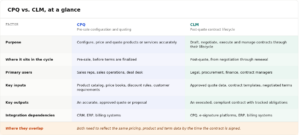
Why CPQ and CLM work better together
When these systems operate in isolation, gaps show up fast:
- Deals approved in CPQ stall when terms get renegotiated manually in CLM, with no record of what changed.
- Pricing agreed to in CPQ doesn’t always carry through into the executed contract, causing confusion and delays.
- Disconnected tools create version control issues, and revenue leakage tends to be the cumulative effect of small handoff errors, not one big mistake.
- Contract errors traced back to quoting gaps add cycle time and compliance risk
None of this is a CPQ problem or a CLM problem on their own. Rather, it’s a handoff problem, and more organizations are solving it by treating quoting and contracting as one connected workflow rather than two tools bridged by hand.
CPQ-CLM integration workflows and best practices
How data flows from CPQ into CLM
In a well-integrated workflow, approved quote data, including product configuration, pricing, and negotiated terms, passes automatically into contract creation. The contract is generated from the quote rather than drafted separately, so the terms a customer agreed to are the terms that show up in the document they sign. No re-entry, no reconciliation, no version drift.
Best practices for a seamless integration
Getting there takes more than turning on an integration.
Field-level data mapping needs to be standardized before go-live so pricing and product data land in the right contract fields. Sales and legal need aligned processes for what triggers a handoff, access controls should reflect who can edit terms at each stage, and clear governance around what approved means in each system keeps the integration from becoming just a faster way to create mismatched documents.
Challenges in CPQ-CLM adoption and how to overcome them
Integration tends to stall for a handful of predictable reasons:
- Ownership misalignment. Sales and legal disagree on who owns the handoff; a single named owner resolves most friction.
- Data mapping gaps. CPQ and CLM platforms aren’t always natively compatible; standardize field mapping first.
- Change resistance. Sales teams unfamiliar with CLM workflows slow adoption; targeted, ongoing onboarding helps.
- Inconsistent templates. Templates that vary by deal type create renewal risk; standardize by deal type.
- Poor data quality at the source. Weak CPQ outputs cause contract errors; validation rules at quote approval catch these early.
Industry use cases for CPQ-CLM integration
CPQ-CLM integration plays out differently depending on how a business sells, but the need for consistency between quote and contract holds across every sector.
SaaS businesses managing subscription terms, renewal clauses, and usage-based pricing must stay consistent from quote to invoice, particularly as multi-year deals introduce escalators and mid-term upsells that both systems need to track accurately.
Manufacturing companies handling complex product configurations alongside multi-party supply agreements, where a single misconfigured bundle can cascade into fulfillment delays and contract disputes with downstream partners.
Professional services firms managing milestone-based contracts and scope change amendments, since change orders renegotiated outside the original quote often create the widest gaps between what gets billed and what was contracted.
Telecom providers with bundled offerings and high-volume contract renewals have thousands of overlapping service agreements that make manual reconciliation between pricing and terms effectively unworkable at scale.
Future trends and innovations in CPQ and CLM
Both categories are moving toward less manual intervention and more predictive capability.
AI-assisted contract generation is pulling directly from approved CPQ data instead of a blank template, and predictive pricing in CPQ is starting to draw on win-rate and margin data to recommend terms, not just enforce rules. CLM platforms are shifting toward continuous contract intelligence with real-time obligation tracking.
As contract and pricing management solutions converge with billing and revenue recognition, more organizations are consolidating several disconnected systems into one unified revenue platform.
Conclusion
CPQ and CLM aren’t rivals for the same budget line. They’re complementary systems that together cover the full quote-to-contract workflow. The businesses getting the most value from both stopped treating the handoff between them as someone else’s problem.
If your team is still reconciling quotes against contracts by hand, or tracing errors back to a gap between sales and legal, that’s the place to start. Often, this doesn’t start with a new tool but with a hard look at how order-to-cash automation and the systems feeding it are or aren’t talking to each other.
FAQs
Do businesses need both CPQ and CLM, or can one replace the other?
Generally, CPQ and CLM systems aren’t substitutes. CPQ governs what gets quoted and priced; CLM governs what gets negotiated, signed, and tracked afterward. Smaller organizations with simple contracts may get by with CLM alone, but complex pricing or sales cycles need CPQ too.
How does CPQ-CLM integration affect average deal cycle time?
Integration removes the manual re-keying that happens when a contract is drafted separately from its quote, cutting the negotiation time attributable to mismatched or missing data, often a significant share of total cycle time in disconnected systems.
Is CLM necessary for small businesses, or only for high-contract-volume ones?
CLM delivers the clearest ROI for high contract volume, multi-party agreements, or heavy renewal dependency. Smaller businesses with a handful of straightforward contracts a year may not need a full platform yet, but manual tracking breaks down quickly as volume grows.
What data security or compliance considerations come with CPQ-CLM integration?
Connecting the systems means pricing and contractual data flow between platforms, so access controls, data residency, and audit trails need consideration on both sides, not just within CLM. This is especially true for regulated industries or cross-border agreements.
How do CPQ and CLM together support revenue operations?
Together, CPQ and CLM give RevOps a consistent thread from the moment a deal is configured to the moment it’s signed, reducing downstream reconciliation work and making quote-to-cash reporting more reliable.
About the Author