














Finance is facing a structural talent crisis decades in the making. New 2026 data reveal just how deep the problem runs and ask whether autonomous AI could be the profession’s lifeline.
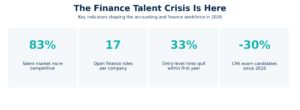 Something structural is breaking in the finance and accounting profession. For years, executives patched the problem with higher salaries and signing bonuses. Now, the 2026 data suggests those bandages aren’t holding. A convergence of demographic trends, educational barriers, early-career attrition, and AI-driven role disruption has created what analysts are calling a “finance talent bubble” on the verge of bursting.
The talent market has turned into something resembling a structural emergency, and the headline is stark: the average number of open accounting and finance roles per company has skyrocketed to 17, up from just two in 2024.
The pipeline that isn’t
The accounting talent shortage didn’t emerge overnight. It’s the result of multiple converging trends that have been quietly eroding the profession’s foundation for more than a decade.
Key pipeline failures
- University degrees: Bachelor’s degrees in accounting fell 10.3% in a single year, from 2021/22 to 2022/23
- CPA exam volume: Candidates sitting for the CPA exam have decreased by more than 30% since 2016
- Entry-level hiring: Companies are hiring 3 senior staff for every 1 junior hire—a 3:1 ratio
- First-year retention: One-third of all entry-level finance hires leave within 12 months
The 150-hour rule, a CPA licensing requirement effectively mandating a fifth year of college, has long been blamed as a key structural barrier. New MIT-backed research found it contributed to a 14% overall decline in new CPAs, with a 26% decline among minority CPAs specifically. States are now racing to respond. Dozens have passed or are pursuing legislation offering alternative licensure pathways, though the full rollout is expected to continue well into 2027.
A compounding problem
Accounting unemployment sits between 1–2%. Meaning nearly every qualified professional is already employed. With a shrinking graduate pipeline, rising retirements among Baby Boomer CPAs, and 33% of juniors leaving within their first year, finance organizations are losing talent faster at both ends than they can replenish from the middle.
What the 2026 data actually shows
BambooHR’s new analysis, spanning six years of workforce data, more than 480,000 employee data points, and 1,200+ surveyed professionals, paints a picture that every CFO and finance leader should understand, particularly those in small and mid-sized organizations. While large companies with 25+ employees are still managing—hiring 3.7%, which slightly outpaces turnover of 3.3%—finance organizations with under 25 employees face a starker reality: turnover of 2.4%) is now outpacing hiring of 1.9%.
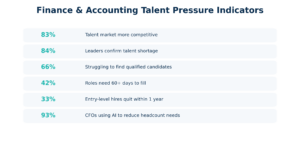
Among the hardest-to-fill roles are senior accountant (43%), staff accountant (26%), and tax accountant (11%). Finance roles requiring a CPA credential now take an average of 73 days to fill, or 41% longer than comparable non-CPA positions.
Root causes of junior talent attrition
There’s a growing mismatch between what new hires expect and what they find on day one, says BambooHR CFO Justin Judd. Unclear job mandates, insufficient structured onboarding, and being thrown in the deep end are accelerating early exits. His prescription: more deliberate onboarding, clearer skills development paths, and treating junior talent as an investment, not an expendable resource.
AI isn’t just part of the problem—it could be the solution
There’s an uncomfortable irony at the heart of this crisis. AI is simultaneously one of the forces disrupting entry-level finance roles and the most credible path out of the talent crunch. It’s true, accounting is having a “wake-up call” as AI eliminates the entry-level work that once trained tomorrow’s senior talent.
But a new generation of technology, agentic AI, offers something fundamentally different from the automation of the past decade. Where traditional AI executes individual tasks on command, agentic AI systems can plan, sequence, and complete entire finance workflows end-to-end without a human coordinating every step.
“Firms will employ at least one virtual agent for every CPA on staff within the next five years. This 1:1 ratio will crush talent shortages and act as a cost-effective way to bolster productivity and curb burnout.”
— Accounting Today, February 2026
Gartner has named agentic AI the top emerging enterprise technology for 2026. Leading US finance teams running agentic close-to-report cycles are seeing 2–3 day close cycles, 40–50% headcount efficiency improvements, and measurable reductions in restatement risk.
What agentic finance looks like in practice
- Autonomous reconciliation. Agents match transactions, surface anomalies, and close matched accounts, routing only exceptions to human reviewers. Goldman Sachs is already running production deployments.
- Real-time forecasting. Agents monitor live financial data, model scenarios, and update forecasts continuously, without waiting for a monthly close cycle.
- Compliance monitoring. Agents apply compliance rules across financial systems automatically, validating transactions against policy and flagging exceptions before they become audit findings.
- Document extraction and matching. Agents extract data from invoices and contracts, match against POs, and post approved entries, eliminating an entire category of junior-level work.
By 2028, Gartner predicts 15% of day-to-day finance decisions will be made autonomously.
But it isn’t a simple fix
The promise of agentic finance is real. But so are the limitations. FloQast CEO Mike Whitmire offers a sobering counterpoint: “The people I set out to help are now spending close cycles doing data prep, patching AI agents, and explaining chat logs to auditors. That’s not transformation, that’s just a different kind of grind.”
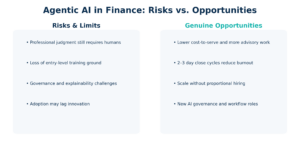
Deloitte analysis shows the most successful agentic finance implementations started with high human oversight and progressively extended agent autonomy as trust built over 2–4 quarters. In their Top Priorities report for 2026, Gartner confirms: 40% of finance leaders are already leveraging AI and automation specifically to address productivity gaps left by talent shortages.
Your new finance talent strategy
The talent shortage won’t self-correct quickly. Even if 150-hour rule reforms unlock new CPA pipelines, the impact won’t be felt for years. Finance leaders need a multi-prong strategy:
- Fix onboarding before hiring more. Junior attrition (33% in year one) is destroying ROI on every hire. Structured onboarding and clear career paths are prerequisites.
- Audit what AI can absorb today. Start with reconciliation, document extraction, and compliance monitoring. Build trust in agentic outputs gradually before extending autonomy.
- Redefine junior roles around AI partnership. New entry-level accountants should be trained to supervise, interpret, and govern AI outputs — not compete with them.
- Benchmark salaries and compete on flexibility. With unemployment at 1–2%, experienced finance professionals hold the leverage. Hybrid work flexibility is now table stakes.
The finance talent bubble is real, and its eventual deflation will be painful for organizations that aren’t prepared. But the same technology disrupting the entry-level pipeline also offers the most credible path to a leaner, faster, and more scalable finance function.
Agentic AI won’t solve the talent shortage overnight. But for finance leaders willing to invest in governance, redesign workflows, and treat AI as a teammate rather than a magic fix, it may well be the most important strategic lever available in 2026.
About the Author