








 Diagnostics








If you’ve ever sat in a planning meeting where someone used bookings, billings, and revenue interchangeably, you know how fast things can go sideways. These aren’t just different words for the same thing—they represent distinct stages in the revenue lifecycle. Conflating them can distort your forecasting, mislead stakeholders, and create real compliance headaches.
For finance leaders managing complex billing arrangements, including subscriptions, usage-based pricing, and multi-year contracts, understanding where each metric lives and what it signals is foundational. This article breaks down what bookings, billings, and revenue actually mean, how they flow into one another, and why getting them right matters more than ever.
Understanding bookings, billings, and revenue
These three metrics are often treated as synonyms when they shouldn’t be. Each tells a different part of your financial story.
What are bookings?
Bookings represent the total value of contracts signed during a given period. When a sales team closes a deal, that value gets recorded as a booking—but no money has changed hands yet, and no product or service has been delivered. Bookings are a leading indicator of future business, which makes them valuable for pipeline visibility and revenue planning. They don’t appear on the income statement, but they feed directly into the metrics that do.
What are billings?
Billings are what you actually invoice to customers, typically following a schedule outlined in the contract. A company might book a $120,000 annual contract in January, but bill quarterly, meaning $30,000 hits accounts receivable every three months. Billings drive cash flow and are a critical signal of operational health. Strong billings growth suggests the business is converting its backlog into real economic activity.
What is revenue?
Revenue is the amount recognized in the financial statements after the corresponding performance obligation has been satisfied under ASC 606. It doesn’t matter when you billed the customer or when they paid—revenue recognition depends on when the service or product was delivered. For subscription businesses, this typically means revenue is recognized ratably over the contract term. That $120,000 annual contract generates $10,000 in recognized revenue each month, regardless of billing timing.
Key differences between bookings, billings, and revenue
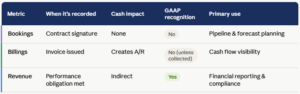
Understanding where each metric sits in this table prevents a common mistake: treating bookings growth as revenue growth, or using billing figures in GAAP financial statements where recognized revenue belongs.
How bookings convert to billings and revenue
The journey from signed contract to recognized revenue isn’t instant, and each transition point has implications for how finance teams should manage their books.
The booking-to-billing conversion
Once a contract is booked, the billing schedule kicks in. Depending on the deal structure—annual upfront, monthly, or milestone-based—billings may start immediately or be spread over time. Finance teams need to track this carefully, especially when contract terms vary across customer segments. A mismatch between booked value and actual billings can signal poor contract execution, early churn risk, or billing errors that inflate receivables without cash backing.
Revenue recognition and deferred revenue
When a customer is billed before the service is fully delivered, the invoiced amount doesn’t immediately become revenue. It becomes deferred revenue, a liability on the balance sheet. As the service is delivered over time, that liability converts into revenue recognition. This is especially relevant for companies with multi-year contracts or subscription models where upfront billings can create significant deferred revenue balances. Managing these balances accurately is a core compliance requirement under ASC 606, and errors are a common audit trigger.
How billings and revenue affect cash flow and forecasting
Billings and revenue play very different roles in financial planning. Treating them the same can produce misleading forecasts.
Billings are a direct driver of cash inflow. A spike in billings, for example, from a large annual renewal cohort, tells you when to expect cash and which directly informs working capital decisions. Revenue, on the other hand, is smoother and more predictable in subscription models, but it’s a lagging signal. You can’t accelerate recognized revenue by billing faster.
For forecasting, finance teams need both. Billing forecasts help with cash management and operational planning. Revenue forecasts drive the income statement and are what external stakeholders, including investors, auditors, analysts, care about the most. Blending the two into a single revenue figure is one of the most common forecasting mistakes finance teams make.
Role in financial reporting and compliance
From a compliance standpoint, only recognized revenue belongs in the income statement. Bookings are an internal management metric. Billings appear on the balance sheet as accounts receivable (if unpaid) or cash (if collected), and any billed-but-unearned amounts land in deferred revenue.
Public companies and those preparing for audit or fundraising need clean delineation between all three. Investors often scrutinize billings as an indicator of near-term cash generation, while auditors focus on whether revenue has been recognized in accordance with ASC 606 or IFRS 15. Mixing up the signals doesn’t just create internal confusion, it creates external exposure.
How billing and revenue connect with SaaS metrics
For SaaS and subscription businesses, bookings, billings, and revenue interact directly with the metrics that define recurring revenue health.
Annual Recurring Revenue (ARR) and Monthly Recurring Revenue (MRR) are derived from recognized revenue in active contracts, not bookings, and not billings. A new booking expands ARR only once the contract is live and revenue is being recognized. Churn, meanwhile, reduces ARR and typically results in fewer future billings, making it a metric that cuts across all three stages of the lifecycle.
Net Revenue Retention (NRR) depends on tracking how revenue from existing customers expands or contracts over time—which requires clean revenue data, not just billing records. Finance leaders who build their SaaS metrics from billing data rather than recognized revenue often end up with an inflated view of their recurring revenue base.
Practical examples and use cases
Consider a software company that signs a three-year enterprise contract for $300,000, billed annually.
Booking: $300,000 recorded at signature
Year 1 billings: $100,000 invoiced, creating an accounts receivable entry
Year 1 revenue: $100,000 recognized ratably, at roughly $8,333 per month
Now imagine that same customer pays the full $300,000 upfront. The billing is $300,000, but revenue recognition doesn’t change. It’s still $8,333 per month over 36 months. The remaining unearned balance ($291,667 in month one) sits as deferred revenue.
This is why a finance team that looks only at cash or billings might think the business is healthier than the income statement suggests, or vice versa. The metrics answer different questions, and you need all three to get the full picture. Understanding the types of billing systems your organization uses also affects how these figures are captured and reported.
Best practices and common pitfalls in managing billing and revenue
Common pitfalls to avoid
- Confusing metrics in board reporting. Using revenue loosely to mean bookings or billings misleads investors and can undermine credibility when the numbers don’t reconcile.
- Forecasting revenue from billings data. Billing timing doesn’t always match revenue recognition, so billing-based forecasts tend to be lumpy and inaccurate.
- Letting deferred revenue go unmanaged. As contracts scale, deferred revenue balances can balloon. Without proper tracking, revenue gets recognized too early or too late—both of which create audit risk.
- Manual processes at scale. Spreadsheet-based revenue tracking breaks down quickly when contracts vary in billing schedules, discounts, and amendment histories.
Best practices
- Maintain separate reporting for bookings, billings, and revenue. Never collapse them into a single line.
- Implement billing automation that links billing schedules directly to revenue recognition rules, reducing manual reconciliation.
- Review deferred revenue schedules regularly and reconcile them to contract terms.
- Train non-finance stakeholders on what each metric means so that discussions in sales, leadership, and investor contexts stay grounded in accurate definitions.
Conclusion
Bookings, billings, and revenue each tell a different part of your company’s financial story. Bookings show where the business is headed. Billings show how it’s executing and generating cash. Revenue shows what’s been earned and what belongs in the financial statements. None of these metrics is more important than the others, but using any one of them to stand in for the rest will leave you with an incomplete and potentially misleading picture.
For finance leaders navigating complex contract structures, the ability to track all three accurately and understand how they interact is a genuine competitive advantage. It supports better cash flow planning, cleaner audits, stronger investor conversations, and smarter operational decisions. And as billing models grow more complex, the systems and processes you put in place to manage this lifecycle become not just a finance function, but a strategic one.
About the Author