








 Diagnostics








GAAP revenue and ARR are often used in the same breath—sometimes interchangeably. They’re not the same thing, and conflating them leads to costly reporting mistakes. This blog breaks down what each metric means, how they’re calculated, where they diverge, and why subscription businesses need both in their reporting toolkit.
What is GAAP revenue?
GAAP—Generally Accepted Accounting Principles—is the standardized framework governing financial reporting in the United States. GAAP revenue is recognized revenue: income a company has earned and is entitled to record on its financial statements. It’s backward-looking, historical, and what your auditors most care about. The governing standard is ASC 606, which established a unified, five-step model for when and how revenue is recorded. Revenue is only recognized when a company satisfies a performance obligation by transferring control of a good or service to a customer.
GAAP revenue definition
GAAP revenue is the amount of income a business has actually earned in a given period, recognized in accordance with ASC 606 (or IFRS 15 for international companies). It reflects when and how much revenue a company is allowed to record—not when cash changes hands, but when the obligation to deliver is fulfilled.
For subscription businesses, this distinction matters enormously. If a customer pays $12,000 upfront for an annual contract, you don’t recognize all $12,000 in month one. You recognize $1,000 per month as services are delivered. Cash collected does not equal revenue recognized.
Recurring vs. non-recurring revenue
GAAP revenue captures everything, both recurring and non-recurring sources. That includes:
- Subscription or license fees (recurring)
- Professional services or implementation fees (often non-recurring)
- One-time hardware or product sales
- Usage-based or variable fees
The distinction between recurring and non-recurring matters a great deal for analysis, but GAAP doesn’t separate them by default. Finance teams often have to do that work manually or with the right revenue management platform.
What is annual recurring revenue (ARR)?
Annual recurring revenue (ARR) is not a GAAP metric. It won’t appear on your income statement, and your auditors won’t ask about it directly. But for subscription-based businesses, including SaaS, telecom, managed services, and logistics platforms, ARR is one of the most important numbers. It represents the annualized value of recurring revenue from active contracts; it’s a forward-looking snapshot of the predictable, contracted revenue your business expects over the next 12 months.
Definition of ARR
ARR is the normalized, annualized value of all active recurring contracts at a given point in time. It excludes one-time fees, professional services, and variable usage charges. Think of it as a run rate view of the subscription revenue base. It’s only meaningful for businesses with predictable, contracted recurring revenue. It’s a less reliable indicator for project-based or highly variable models.
Use cases of ARR
ARR shows up in nearly every high-stakes conversation subscription businesses have:
- Investor reporting and fundraising: ARR is a primary lens for valuation in SaaS and recurring revenue businesses
- Sales forecasting: tracking ARR movement (new, expanded, churned, contracted) reveals pipeline health
- Customer success: declining ARR is an early warning signal for churn risk
- Executive dashboards: ARR trends tell the story of business momentum better than any single GAAP line item
Related metrics: MRR, CARR, and others
ARR doesn’t exist in isolation. Here are a few closely related metrics worth knowing:
- MRR (Monthly Recurring Revenue): ARR divided by 12. Useful for month-to-month tracking and shorter-cycle businesses
- CARR (Committed Annual Recurring Revenue): includes signed contracts not yet live, giving a more forward-looking view than ARR alone
- Net Revenue Retention (NRR): measures how ARR changes within an existing customer cohort over time, accounting for expansion, contraction, and churn
Each metric serves a different purpose, and sophisticated finance teams use them in combination rather than in isolation.
Calculation methods for GAAP revenue and ARR
GAAP revenue calculation
GAAP revenue is calculated by following the ASC 606 five-step model:
- Identify the contract with the customer
- Identify the distinct performance obligations within the contract
- Determine the transaction price
- Allocate the transaction price to each performance obligation
- Recognize revenue when (or as) each performance obligation is satisfied
For a SaaS subscription, that typically means straight-line recognition over the contract term. For a professional services engagement, it might mean percentage-of-completion or milestone-based recognition. The complexity multiplies quickly for bundled contracts with multiple deliverables.
ARR calculation
ARR calculation is more straightforward in theory. The basic formula:
ARR = (Total Active Recurring Contract Value) / Contract Term in Years
More simply: if a customer is on a $24,000/year subscription, they contribute $24,000 to ARR. If they’re on a monthly plan at $2,000/month, they contribute $24,000 to ARR ($2,000 × 12).
The complication comes from edge cases such as mid-term upgrades, multi-year deals with ramp pricing, usage-based components layered on top of a base fee, or contracts in non-standard currencies. These scenarios are where ARR calculation gets messy fast—and where consistent definitions across the organization become critical.
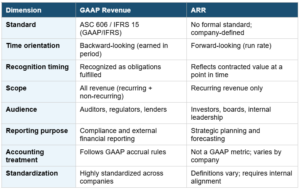
Key differences between GAAP revenue and ARR
Here’s a side-by-side look at how these two metrics compare across the dimensions that matter most:
Common challenges and mistakes in ARR reporting
ARR looks deceptively simple. But in practice, it’s one of the most error-prone metrics in subscription finance. Here’s where things tend to go wrong:
- Inconsistent definitions. Sales might count a signed contract toward ARR the moment the ink dries; finance might wait until it goes live. If both numbers exist in different spreadsheets, leadership is working from different realities.
- Including non-recurring revenue. Implementation fees and one-time charges don’t belong in ARR. Including them inflates the number and distorts trends.
- Mishandling churn. Net churn accounting, which factors in expansion from existing customers, requires careful tracking. Underreporting churn is a common and costly mistake.
- Ignoring ramp deals. Multi-year contracts with escalating fees need to be normalized. Counting year-three pricing as current ARR misrepresents the actual run rate.
- Double-counting. Adding upgrades or renewals to ARR without removing the old contract value makes ARR grow on paper without any real change in business.
The fix isn’t just process, it’s systems. Manual ARR tracking in spreadsheets is a recipe for exactly these kinds of errors, especially as contract volume grows.
Practical applications and tools for managing ARR and revenue
For finance teams operating at scale, managing GAAP revenue and ARR simultaneously requires more than good spreadsheet hygiene. It requires infrastructure.
The most effective approach combines automated revenue recognition—handling the ASC 606 mechanics for GAAP revenue—with purpose-built ARR tracking that reflects your specific contract structures and business rules. In practice, that means:
- Automated revenue schedules that generate recognition timelines based on contract terms, eliminating manual allocation work across periods
- Real-time ARR dashboards that update as contracts are signed, modified, or canceled—no monthly spreadsheet reconciliation required
- Audit-ready reporting with a full data trail, critical for both GAAP compliance and investor due diligence.
- Scenario modeling that lets finance leaders project the revenue impact of pricing changes, churn assumptions, or new contract structures before committing.
RecVue’s revenue recognition solution is built for businesses with complex contract structures, including multi-element arrangements, usage-based components, and revenue that doesn’t fit neatly into simple subscription models. By automating both GAAP recognition and ARR tracking in a single platform, finance teams close faster and reconcile less.
Conclusion
GAAP revenue and ARR aren’t competing metrics—they’re complementary ones. GAAP revenue tells you what you’ve earned and how you’re performing against your compliance obligations. ARR tells you the health and trajectory of your recurring revenue base.
Subscription businesses that rely on only one of these metrics are flying partially blind. GAAP alone doesn’t give you the forward-looking visibility investors and operators need. ARR alone won’t satisfy auditors or capture the full picture of financial performance. When your GAAP revenue and ARR data are clean, automated, and reconciled, your finance team spends less time chasing numbers and more time using them.
About the Author